
Fairness in the Global Supply Chain
Transport is a significant component of the economy of a country. This is even more so in a global economy where economic opportunities are increasingly related to the mobility of people and goods, including information and communication technologies. Without transport workers, supply chains would virtually collapse, leading to severe disruptions in the availability of food, fuel and manufactured goods worldwide.
An ethical supply chain includes:
fair and responsible practices that prioritize human rights at every stage of the supply chain, including fair and safe working conditions, fair wages and the elimination of forced labour and child labor;
environmental sustainability by minimizing waste, reducing carbon emissions, and promoting responsible resource management;
transparency and traceability of products and ensuring that suppliers uphold ethical principles; fair trade practices that promote equitable relationships with suppliers and fair competition;
social responsibility, such as contributing to the communities in which businesses operate, support social initiatives, and engage in philanthropic activities;
continuous improvement. Ethical supply chains require ongoing commitment to continuous improvement.

Fair Treatment of Maritime Workers
The term ‘fair treatment’ reflects broad principles of social justice embodied in human rights instruments, norms of corporate social responsibility, the ESG framework, UN Sustainable Development Goals, and of course, labour standards.
The fair treatment of maritime workers is a fundamental prerequisite for the stability and efficiency of the global maritime transport system, which moves approximately 90 per cent of world trade. Seafarers are essential actors in this economic dynamic. They support the movement of goods, energy supplies, and raw materials. Their safety, well-being and remuneration correlates directly to the reliability and resilience of supply chains.
Fair treatment is not only a moral imperative; it is also an economic rationale. Exploitative practices lead to high turnover, reduced productivity, and increased risks of accidents, factors which can disrupt trade and increase costs of production.

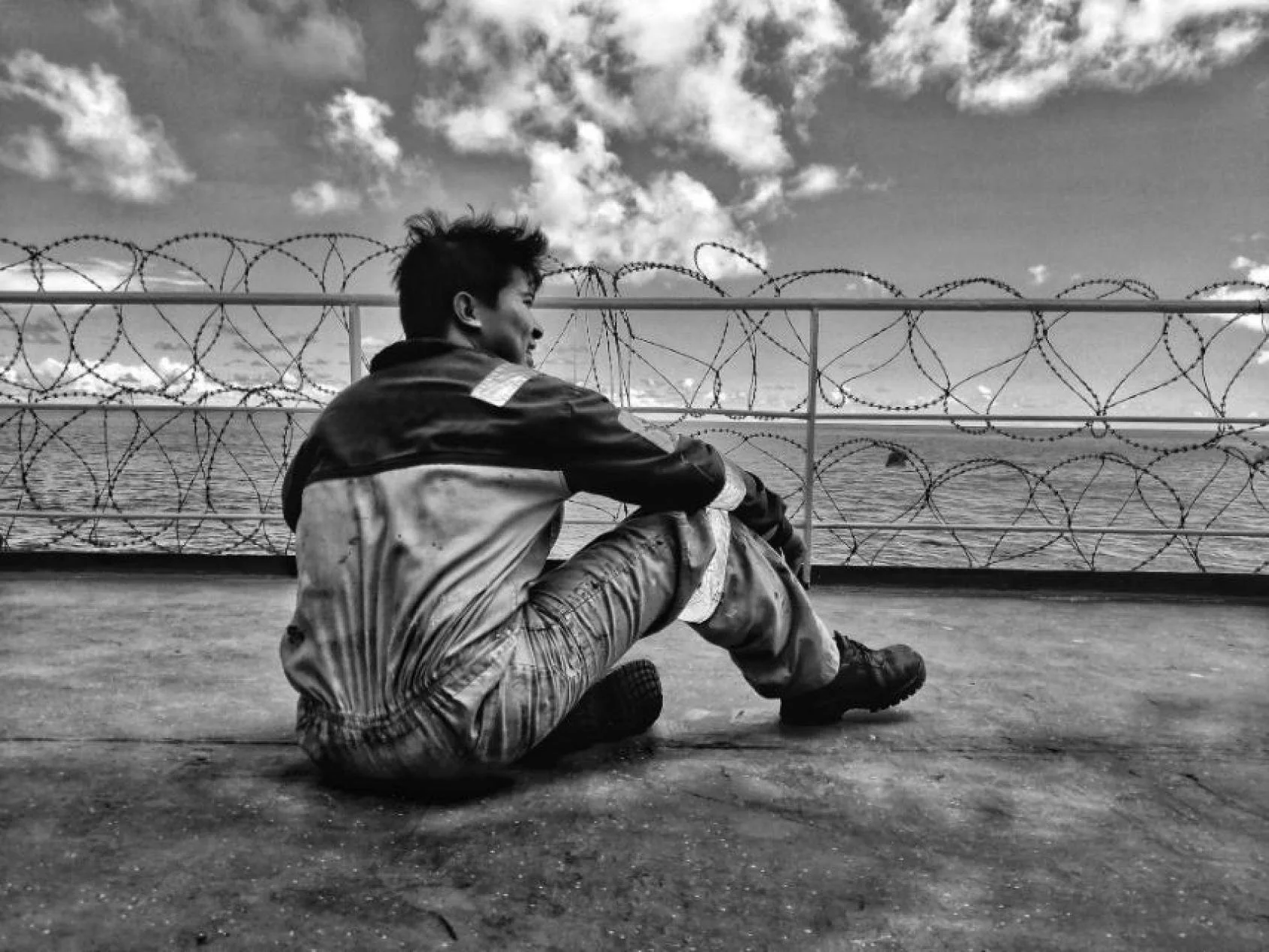
The Dream is Within Reach, Navotas Port, Philippines, by John Prieto
Criminalisation of Seafarers
Criminalisation of seafarers refers to the growing practice of holding ship crews personally and criminally liable for maritime incidents that are often accidental, systemic, or caused by factors beyond their control.
It can also refer more generally to the application of national criminal laws to foreign seafarers, and the circumstances where this arises.
For seafarers, the risk of facing criminal investigations is an ever present one. Ships routinely operate within and across different national jurisdictions. Indeed, the average ship spends a greater part of its time in areas that are beyond the jurisdiction of any specific state. It is widely accepted that given the global nature of shipping and the different jurisdictions seafarers come in contact with, they need special protection.
Guidelines
The Guidelines on Fair Treatment of Seafarers in the Event of a Maritime Accident were originally adopted in 2006 as industry stakeholders and legal experts observed a pattern of seafarers’ detention following marine accidents or incidents. The Guidelines serve to ensure that seafarers involved in a maritime accident are treated fairly during investigations and any subsequent procedure. The Guidelines emphasise access to legal representation, protection against coercion and intimidation, respect for human rights, and continued access to wages, medical care, and repatriation.
SRI has worked conspicuously in international fora to advance an understanding and implementation of the Guidelines. In 2017, SRI gathered government representatives from over 50 countries to harness support for national legislation on the Guidelines. International Conference on Fair Treatment of Seafarers, 2017, London
In 2018, in partnership with the Philippines’ Department of Labor and Employment (DOLE), SRI organised a conference to share best practices and develop resources on the Guidelines. The Conference resulted in the adoption of the Manila Statement, a commitment by 11 regional States to: raise further awareness of the Guidelines; develop education, training and human capacity relating on the Guidelines; and extend regional and international cooperation. Regional Conference on Fair Treatment of Seafarers, 2018, Manila
More recently, an IMO-ILO Tripartite Working Group adopted the Guidelines on Fair Treatment of Seafarers Detained in Connection with Alleged Crimes. The 2025 Guidelines promotes judicial principles such as the presumption of innocence until proven guilty, the prohibition of arbitrary detention; the premise that no seafarer, in particular the Master, should be detained on suspicion of committing a crime solely on the basis of their status onboard. The Guidelines seek to ensure that seafarers detained on suspicion of committing a crime are treated fairly during any investigation and detention, and that detention is for no longer than necessary.
Both the Guidelines on Fair Treatment of Seafarers in the Event of a Maritime Accident and the Guidelines on Fair Treatment of Seafarers Detained in Connection with Alleged Crimes were included in the MLC as part of the amendments adopted in April 2025.
Seafarer Abandonment
“Seafarers are highly vulnerable to unjust abandonment and criminalisation due to weak legal protections, lack of international enforcement, and the complexities of maritime jurisdiction.”
Abandonment of seafarers refers to the circumstances where shipowners fail to meet their legal and contractual obligations to the crew, leaving them stranded—often without wages, food, medical care, or means of repatriation.
The Maritime Labour Convention 2006, as amended defines abandonment as instances where the shipowner fails to cover repatriation costs; leaves the seafarer without the necessary maintenance and support; or, otherwise unilaterally severs ties with the crew, including failure to pay contractual wages, for a period of at least two months.
The International Transport Workers’ Federation (ITF) warned that abandonment of seafarers reached record levels in 2025. The ITF documented 6,223 abandoned seafarers across 410 ships in 2025. These figures represent the sixth consecutive year where the number of abandoned vessels exceeds previous years and the four year in a row for record breaking abandoned seafarers.
Dave Heindel, Chair of the ITF Seafarers’ Section said that: “It’s very clear that this is a systemic issue in the industry – and that means we need the entire industry to come together …”.
In light of the latest figures, the CEO of SRI, Professor Hilton Staniland observed that: “Abandonment is not inevitable, it is the predictable result of regulatory gaps and weak accountability. Flag States, port States and the maritime industry itself have the tools to address it. Requiring full transparency of beneficial ownership as a condition of ship registration would be a decisive step. Treating the deliberate and avoidable abandonment of seafarers as an international criminal offence would send an equally clear signal.” See SRI Press Release
SRI has worked with governments, shipowners, trade unions and UN agencies to promote the implementation and enforcement of the MLC including the provisions on financial security to combat seafarer abandonment. In 2024, SRI published a comprehensive study on the effectiveness of the MLC. 2024 MLC Project
Abandonment
Criminalization of Seafarers
Just Transition is about shifting toward a more sustainable and low-carbon economy while ensuring that workers—especially those in high-impact sectors like transport—are not left behind.
For transport workers, this means adapting to new environmental policies, automation, and digitalisation without being forced to sacrifice fair wages, job security, or working conditions. For Just Transition to be successful, transport workers will need to be part of the decision-making process.
Read more about the Maritime Just Transition Task Force that was launched at COP 26 in 2021. It is the first global sectoral task force dedicated to a just transition, enabled by the international nature of the maritime industry. Maritime Just Transition Task Force
Spotlight: 2030 Agenda for Sustainable Development – Goal #8
“Transforming Our World: The 2030 Agenda for Sustainable Development” is a United Nations resolution establishing a plan of action for “people, planet and prosperity.” Of the Agenda’s 17 Sustainable Development Goals (SDGs), Goal #8 focuses on promoting inclusive and sustainable economic growth, employment and decent work for all.
8.1 Sustainable Economic Growth
Sustain per capita economic growth in accordance with national circumstances and, in particular, at least 7 per cent gross domestic product growth per annum in the least developed countries
8.2 Diversify, Innovate and Upgrade for Economic Productivity
Achieve higher levels of economic productivity through diversification, technological upgrading and innovation, including through a focus on high-value added and labour-intensive sectors
8.3 Promote Policies to Support Job Creation and Growing Enterprises
Promote development-oriented policies that support productive activities, decent job creation, entrepreneurship, creativity and innovation, and encourage the formalization and growth of micro-, small- and medium-sized enterprises, including through access to financial services
8.4 Improve Resource Efficiency in Consumption and Production
Improve progressively, through 2030, global resource efficiency in consumption and production and endeavour to decouple economic growth from environmental degradation, in accordance with the 10-year framework of programmes on sustainable consumption and production, with developed countries taking the lead
8.5 Full Employment and Decent Work with Equal Pay
By 2030, achieve full and productive employment and decent work for all women and men, including for young people and persons with disabilities, and equal pay for work of equal value
8.6 Promote Youth Employment, Education and Training
By 2020, substantially reduce the proportion of youth not in employment, education or training
8.7 End Modern Slavery, Trafficking and Child Labour
Take immediate and effective measures to eradicate forced labour, end modern slavery and human trafficking and secure the prohibition and elimination of the worst forms of child labour, including recruitment and use of child soldiers, and by 2025 end child labour in all its forms
8.8 Protect Labour Rights and Promote Safe Working Environments
Protect labour rights and promote safe and secure working environments for all workers, including migrant workers, in particular women migrants, and those in precarious employment
8.9 Promote Beneficial and Sustainable Tourism
By 2030, devise and implement policies to promote sustainable tourism that creates jobs and promotes local culture and products Source: International Labour Organization